
From the “Second Grade Strategy Manual”
To develop a shared strategic perspective, it’s important to articulate both a plan for what we’re trying to do and a narrative of what we’ve done. This allows us to work together to refine our specific organizational perspective and share it with others, outside of the Center for Especifismo Studies (CES), in the form of writings, discussion groups, and public seminars.
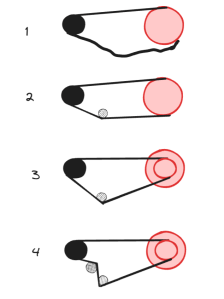
We begin with the inclusion of this internal strategy document:
A. “de la nada”, sin historia ni ideología
B. con militancia política adentro de un ciclo estricto
C. entre dos modos sociales en el mismo ciclo
D. en una dinámica política que permite varias combinaciones estratégicas para conectar lo social y lo político
• On the social level (in red), everyone has the potential to participate and “push the cycle” to continue. This is the basis of social force. It can always be organized more efficiently and with more people, but since it isn’t ideologically specific, social force doesn’t have to be subordinate to the political level (in black). However, this also means that the political decisions of a movement are not always influenced by the rank-and-file participants.
• A small motor is a good metaphor to understand a revolutionary political strategy that isn’t vanguardist, but a motor assumes the smooth functioning of basic mechanisms. Today, in regard to organizing culture, this assumption is wrong. Bicycles, with their gears, chains, and exposed shifting, offer a simple machine model that is a more useful didactic tool.
• Without a mechanism for adding tension, the political level is only loosely influenced by the social level and depends on the connecting mechanism to keep itself from coming loose, despite the inevitable bumps and fluctuations. When this connection is lost, when the “chain” falls off, the two levels become disengaged and mass movements come to a stop.
• If the social demands are high but the political influence is low, then a cycle of struggle requires too much force to sustain for very long. So, the concept of “gears” allows us to strategize around various combinations of social-level demands and political-level influence.
The Political Organization:
1. front-line work: immediate forms of participation on the social level that are independent from the political cycle, but that have no way of influencing the decision-making on the political level
2. rear-guard work: consistent tension on the political cycle of the movement, preventing anarchist disengagement and allowing others to come in contact with the political organization
3. two modes: a “pivoting and springing” dynamic that can stay connected to the social level as it oscillates between modes (bigger/smaller, mobilizing/meeting, conflict/recovery, motivation/burnout, summer/winter, public/clandestine, local/remote)
4. coordinated gears: influence on the political level through multiple combinations of modes, forms, and techniques of social insertion
 CES
CES 